To make your house smell good, start with the smells you do not want.
Trash, damp towels, cooking odors, laundry, upholstered fabrics, and stale rooms can all compete with whatever fragrance you add next. Once those sources are under control, decide what you actually want the home to smell like.
The next step depends on the space. One bedroom, a studio apartment, a large open living area, and several connected rooms do not distribute fragrance in the same way.
1. Make the House Smell Neutral Before You Make It Smell Fragrant
Before adding scent, check places that commonly hold or generate odors:
-
kitchen trash and food waste;
-
sinks and drain areas;
-
damp towels and bath mats;
-
laundry and shoes;
-
bedding;
-
rugs, curtains, and upholstered furniture;
-
pet areas;
-
rooms that have stayed closed or poorly ventilated.
Empty food waste, wash fabrics that retain odors, and allow damp items to dry.
When conditions allow, normal ventilation can also help after cooking or when a room feels stale.
If an odor keeps returning, trace it to the source before layering fragrance over it. Once the room has a more neutral baseline, it becomes much easier to judge both the fragrance itself and the amount you actually need.
What If You Want Your House to Smell Good Naturally?
The same first step applies.
Fresh air, clean fabrics, dry towels, fresh flowers, herbs, citrus peels, or a simmer pot can all contribute to how a home smells without requiring a permanent fragrance source.
These methods are especially useful when you want a temporary scent or simply want the home itself to smell fresher.
The sequence remains straightforward:
Remove the unwanted smell first. Add the scent you want second.
2. Match the Fragrance Method to the Space
Floor area matters, but it is not the only factor.
Doors, partitions, ceiling height, airflow, and placement all change how fragrance moves through a home.
One Room
For a bedroom, home office, or ordinary living room, keep the setup local.
If you use a diffuser or another continuous fragrance source, avoid placing it where the output is directed immediately toward a bed, desk, sofa, or another place where someone stays for long periods.
Judge the scent from where you actually spend time in the room.
Apartment or Studio
In a compact layout, cooking, living, and sleeping areas may share much of the same air.
One fragrance source can affect several areas, so adding multiple strong scents often makes the result harder to control.
Start with one scent at a restrained intensity. Walk through the apartment and check how noticeable it is in each area before adding more.
One Large Open Area
An open-plan kitchen and living room is a different problem from several closed rooms.
High ceilings, open staircases, furniture, and airflow can make fragrance feel stronger in one part of the space and weaker in another.
If you use a diffuser, choose a format suitable for the larger open area rather than compensating for poor distribution simply by increasing the output.
Several Connected Rooms
For several rooms, first decide where fragrance actually needs to reach.
Closed doors, separate airflow paths, and different room uses can make one centralized scent source less effective. In homes with compatible ductwork serving the intended spaces, HVAC-connected scenting is one possible distribution method.
The important question is not simply:
How large is the house?
It is:
Which spaces need fragrance, and how does air already move between them?
3. How to Keep Your House Smelling Good All the Time
Consistency starts with maintaining the baseline.
Food waste, laundry, damp fabrics, and recurring odor sources still need attention even when the home uses fragrance regularly.
Once that is under control, three things matter most: scent direction, intensity, and routine.
Keep the Scent Direction Coherent
Every room does not have to smell identical.
But if adjoining rooms use several fragrances, profiles with some relationship between them usually create a more coherent transition.
For example:
-
tea, soft musk, and light florals;
-
citrus, bergamot, and green notes;
-
sandalwood, amber, and softer woods.
The exact combination is personal. The useful goal is to avoid making every doorway feel like a completely unrelated fragrance at full strength.
Start Lower and Adjust Slowly
Begin at a restrained intensity.
After sitting around the same fragrance for a while, you may notice it less than you did on arrival. Before increasing the output, step outside the room and return later.
If it still feels weak, check the fragrance source, placement, airflow, and operating routine before changing several things at once.
Another person's impression can also be useful because they may be entering the room without the same prolonged exposure.
Use a Schedule to Build Consistency
If you use continuous scenting, a predictable schedule can create a more stable result than manually turning the fragrance up and down throughout the day.
Plan the operating periods around when the room is actually used. Morning, evening, and empty hours do not necessarily need the same routine.
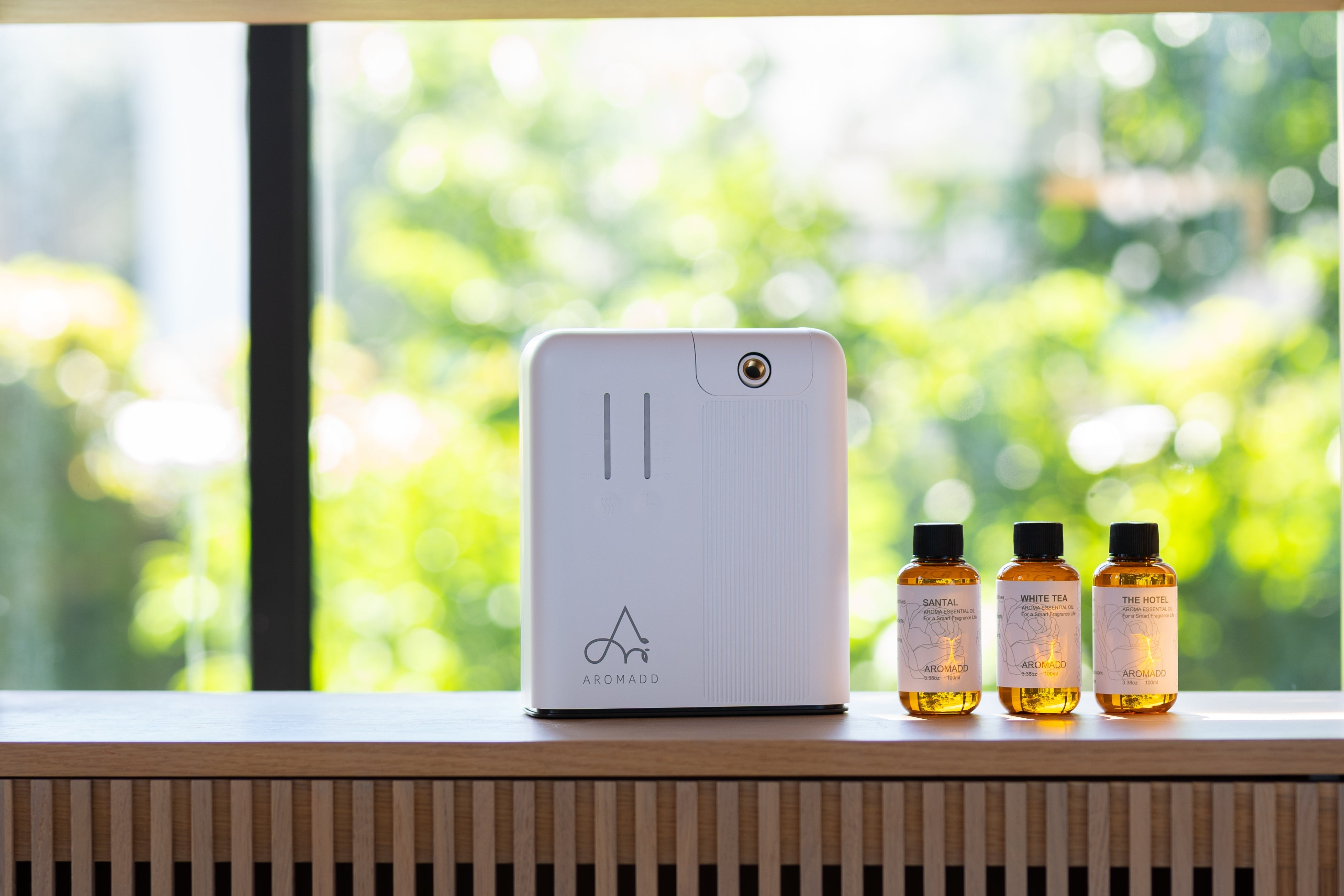
If you use an Aromadd diffuser, App-based scheduling and scent programming are supported across Aromadd diffusers, so the routine can be set in advance.
Judge the Scent From More Than One Position
Check the fragrance when you enter, but also check it from the sofa, bed, desk, or other places where you spend time.
A room can smell pleasant at the doorway and still feel too strong next to the fragrance source.
If that happens, change placement or output rather than assuming the entire room needs more or less fragrance.
4. How to Make Your House Smell More Like a Hotel
A hotel-inspired home scent is less about finding one special “hotel scent” and more about consistency.
Start with the same clean baseline. Then choose a fragrance direction that you would enjoy repeatedly rather than rotating through several unrelated strong scents.
White tea and soft musk, citrus and bergamot, clean florals, soft woods, or restrained amber-wood profiles can all create different versions of a polished home fragrance.
The distribution matters too. A room often feels more naturally scented when fragrance seems to belong to the space rather than coming strongly from one obvious source.
Hotel-like does not need to mean stronger. It can simply mean more coherent and more consistent.
A Good-Smelling Home Starts With What You Remove
When the house smells off, find the source first.
When the fragrance feels uneven, check the placement and airflow.
When the scent seems weaker after you have been around it for a while, leave the room and reassess before increasing the output.
Knowing which problem you are actually solving makes the next adjustment much more useful.

Leave a comment
This site is protected by hCaptcha and the hCaptcha Privacy Policy and Terms of Service apply.